
Honors student explores interdisciplinary climate leadership through Climate Way-finding program
By: Isabella Lebron
Honors College student and Chancellors Scholar Samantha Dunn participated in App State’s The All We Can Save Project’s Climate Way-finding program September 18-20, 2026 supported by App State’s Sustainability Initiatives and the Pathways to Resilience Quality Enhancement Plan. Through her participation in Climate Way-finding, Dunn demonstrates how intellectual curiosity, interdisciplinary engagement and a commitment to service can help students translate their academic interests into meaningful contributions to the world around them.
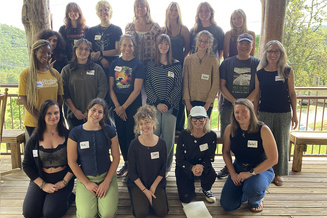
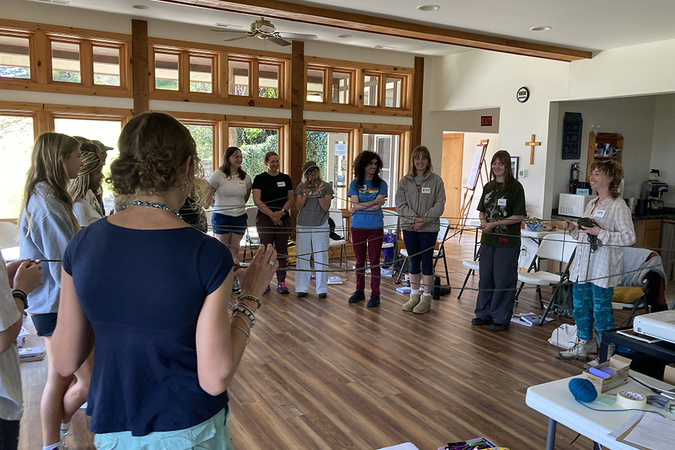
The program brought together students and faculty from various academic disciplines to explore climate leadership through three guiding principles: looking inward with care, outward with curiosity and forward with courage. This climate leadership development helped participants identify their individual strengths, explore approaches to climate action, and develop a deeper understanding of their roles in creating a sustainable future.
Trying to understand your own climate contribution can be incredibly overwhelming, but this program really helps highlight what strengths you already bring to the table that can help build a more sustainable future, Dunn said.
Dunn’s interest in environmental conservation began during childhood, when her appreciation for the natural world developed into a growing awareness of the challenges posed by climate change.
“I have been concerned with climate change ever since I was a young girl. I always immersed myself in the natural world around me,” Dunn said.
Dunn explained that addressing climate change begins with a simple but powerful idea—everyone has something meaningful to contribute.
As I began to understand what climate change truly was and the potential damage that it could cause to the people and places that I loved dearly, I felt called to play my part.
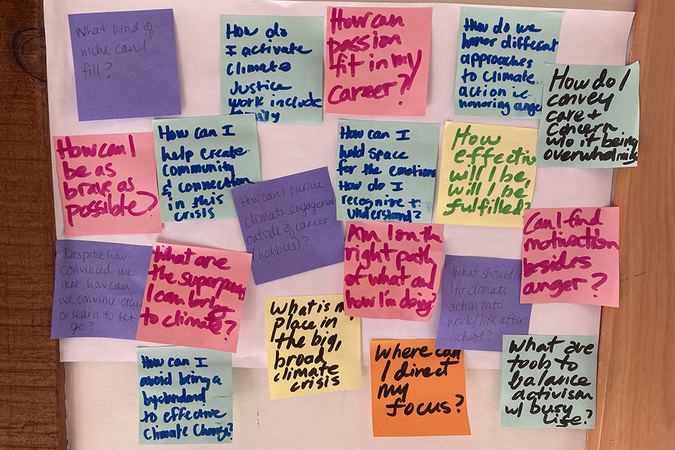
Dunn is pursuing a career in wildlife biology and conservation, and through this program sought an opportunity to expand her understanding of climate change beyond her academic discipline.
The program’s interdisciplinary approach also reinforced Dunn’s understanding that climate solutions require collaboration across academic fields and professional backgrounds.
“Hearing from other students (especially since everyone had very different majors), was very enlightening because it helped me realize how different disciplines all have an important role to play in the climate crisis,” Dunn said.
Throughout the program, participants examined their personal relationships with climate action and considered how different perspectives can contribute to addressing environmental challenges.
For Dunn, the principle of looking “outward with curiosity” was particularly meaningful.
“Many people tend to avoid conversations about climate change because it can be so incredibly overwhelming, and it is,” Dunn said. “I think a crucial part behind all of this, regardless of your level of concern with the environment, is the curiosity to ask these questions and continue to ponder how our actions shape the world around us.”
Dunn is already applying these principles to her academic pursuits at App State. As a student researcher in the Davenport Lab, she contributes to herpetological research primarily focused on salamanders, gaining experience that supports her aspirations for a career in wildlife conservation.
She also recently declared a minor in climate studies, a new interdisciplinary program introduced at App State this fall.
“This minor allows me to raise my climate awareness in an interdisciplinary way which is very meaningful to me as I want to contribute to climate solutions not just in my career, but in other approaches too,” Dunn said.
Dunn encourages other Honors College students interested in sustainability to explore opportunities that connect individual interests and abilities with broader environmental initiatives.
She recommends organizations such as the Mountaineer Climate Corps, Appalachian Conservation Corps and State Sustainability and Environmental Education Club, as well as the university’s climate studies minor.